Quantum Remote
Sensing for Earth Observation
Quantum remote sensing represents the next paradigm in how we measure Earth’s mass change from space. NASA’s 2017–2027 Decadal Survey for Earth Science identified mass change as one of five Designated Observables essential to understanding our changing planet.
Traditional satellite gravimetry missions have made significant contributions, but existing technologies fall short of meeting the precision and resolution needed for critical geophysical goals of the next generation. By advancing quantum sensing, QPI seeks to overcome these limitations, providing a transformative leap in observation accuracy. This work has direct implications for monitoring and managing shifting water resources, understanding natural hazards and the long-term interplay between nature and habitability, and advancing future generations of pointing and navigation systems.
From Laboratory Innovation to Spaceflight Readiness
QPI is committed to bridging the gap between laboratory breakthroughs and space-ready technologies. Our central goal is to mature quantum gradiometer systems to Technology Readiness Level 3 and beyond, ensuring that they are viable for space deployment. This process involves discovering new solutions that enhance accuracy, reduce mission costs, and ensure resilience in harsh space environment.
- Technology maturation toward TRL3+
- Increased observation accuracy and sensitivity
- Reduced Size, Weight, and Power (SWaP) requirements
- Development of spaceflight mission concepts
QPI Research Objectives
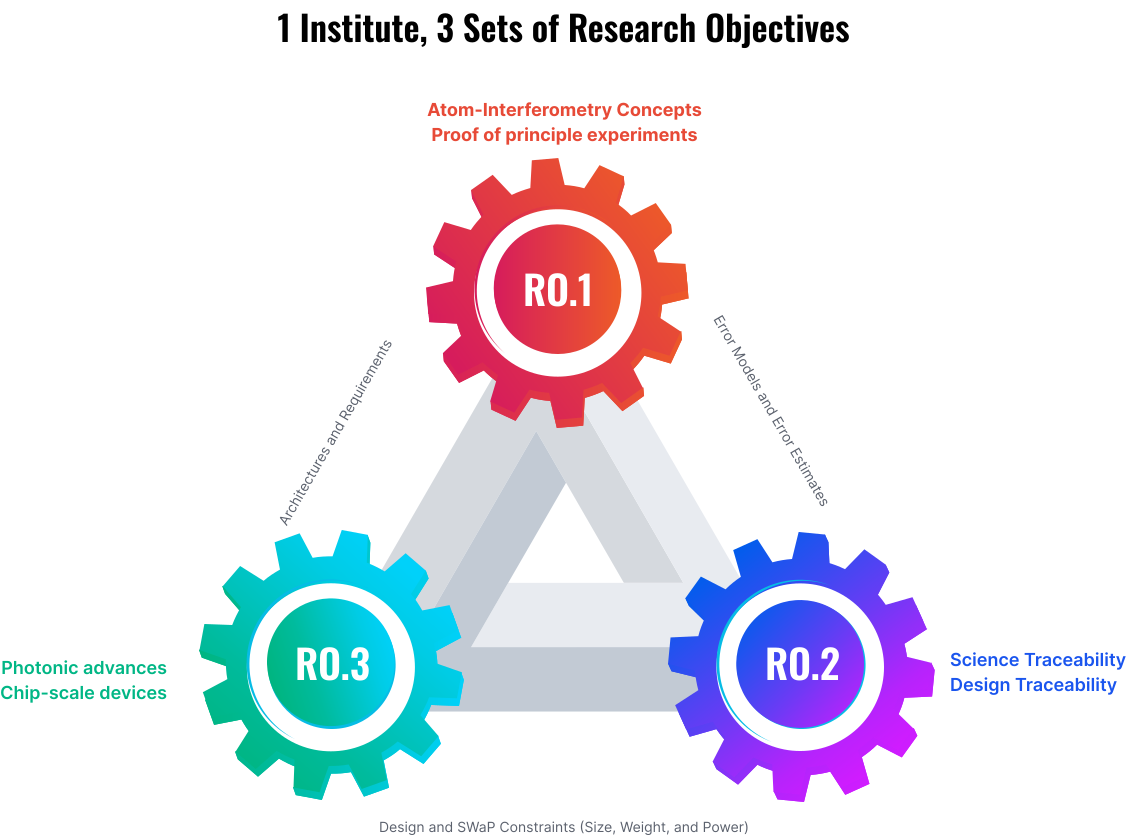
The Institute’s research is organized into three interconnected groups, each critical to the advancement of quantum sensing from space. These areas—Atomic Physics, Aerospace Systems Engineering, and Photonics—are deeply interdependent, ensuring progress at both the applied physics and engineering levels
Atomic Physics (RO1)
Advancing quantum sensing begins at the atomic level, where interferometry provides the foundation for ultra-sensitive measurements.
- Conduct atomic interferometry and
proof-of-principle experiments - Develop innovative techniques such as
Bloch-band interferometry - Implement 3D shaken optical lattice
methods - Apply machine learning to develop novel atom-optic components for quantum sensing protocols
- Explore novel approaches for enhancing
coherence and sensitivity
Aerospace Systems Engineering (RO2)
Integrating quantum sensors into space missions requires robust aerospace systems engineering. QPI is developing mission-level concepts and tools that will enable quantum instruments to succeed in orbit.
- System engineering concepts for TRL3
quantum instruments - Spacecraft design methodologies
tailored to quantum payloads - Decision processes for mission
architecture and trade studies - Advances in attitude control and orbit
maintenance strategies - Machine learning applications for
spacecraft design and operations
Photonics for Spaceflight (RO3)
Photonics underpins the miniaturization and scalability of quantum sensing systems. QPI focuses on photonic integration to enable compact, chip-scale solutions for space deployment.
- Advancing semiconductor structures for quantum devices
- Epitaxial crystal growth for stable, narrow linewidth light sources
- Exploring next generation optical components for space environment
- Development of chip-scale atom trapping and manipulation [e.g. magnetic optical traps (MOTs) and Bose-Einstein condensates (BEC)]
- Photonic integration for robustness in spaceflight